


If you've been told you may need brain or nerve surgery — start here.
This page is for people who have been referred to Dr. Cajigas, are considering a referral, or simply want to understand what we do before talking with their own doctor. The language is plain on purpose. Acronyms and clinical terms are explained the first time they appear, and a glossary is linked at the bottom of the page if you want to look up a specific term.
Four common reasons people come to us.
Pick the one that fits. Each link jumps to the section of this page that explains the conditions we treat, the procedures we offer, and what the path looks like.
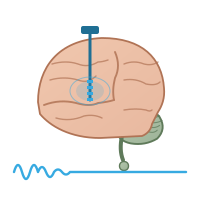
I have a movement disorder.
Parkinson's disease, essential tremor, or dystonia — and medications alone aren't doing enough.
Read what we offer →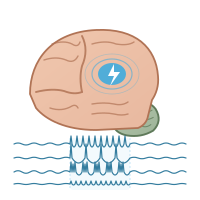
I have epilepsy or seizures.
Seizures that haven't fully responded to medications, and the question of whether surgery could help has come up.
Read what we offer →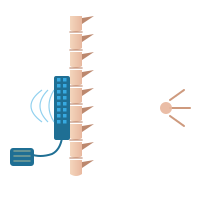
I have face pain or nerve pain.
Trigeminal neuralgia, occipital neuralgia, refractory back pain, CRPS, painful diabetic neuropathy, or refractory headache when other treatments haven't been enough.
Read what we offer →I had a stroke and my arm hasn't fully recovered.
An ischemic stroke 6+ months ago, with persistent arm or hand weakness — and you want to try something beyond standard rehabilitation.
Read what we offer →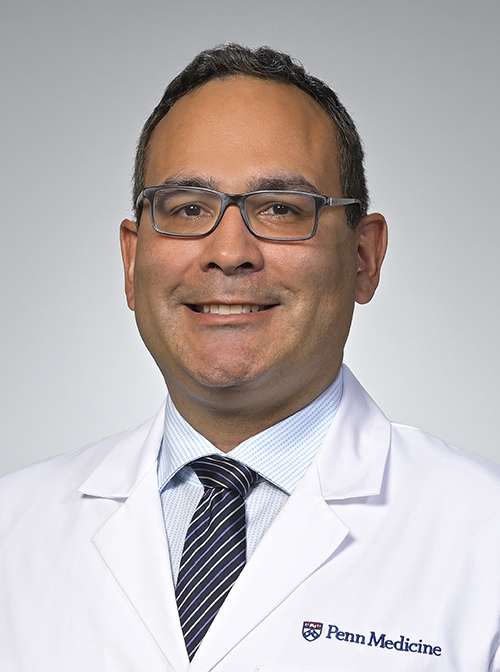
Dr. Iahn Cajigas, MD, PhD
Dr. Cajigas is a neurosurgeon at Penn Medicine who specializes in functional and stereotactic neurosurgery — the area of neurosurgery focused on movement disorders, epilepsy, and pain rather than tumors or trauma. His clinic is at Pennsylvania Hospital in Center City Philadelphia, with additional appointments available in Lancaster.
He completed his medical and doctoral training at Harvard University and MIT, neurosurgery residency at the University of Miami / Jackson Memorial Hospital, and a fellowship in epilepsy and stereotactic neurosurgery at the University of California, San Francisco.
He's a member of the Penn Comprehensive Epilepsy Center, the Penn Movement Disorders Center, and works closely with the Penn Comprehensive Stroke Center on neuromodulation for chronic stroke recovery. These centers evaluate patients as a team — a neurologist, a neurosurgeon, and the relevant subspecialist (epileptologist, movement-disorders specialist, or stroke neurologist) will typically see you together before any surgery is recommended.
Movement disorders.
If your hands shake, your body stiffens, you have unwanted movements, or your medications have stopped working, surgery is sometimes an option. We don't offer surgery as a first step — we work with the neurologists at the Penn Movement Disorders Center to make sure it's the right next step for you. The right operation depends on the condition, the symptoms that bother you most, and what you can tolerate.
Conditions we treat
- Parkinson's disease — for tremor, stiffness, slowness, and medication-related involuntary movements (dyskinesia).
- Essential tremor — when medications have stopped controlling the shaking.
- Dystonia — generalized, focal (cervical, blepharospasm), and severe acute episodes (status dystonicus).
Procedures we offer
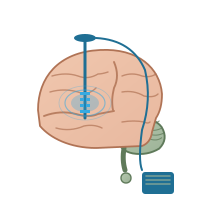
- Deep brain stimulation (DBS) — a thin wire is placed in a specific brain area and connected to a small pacemaker-like device under the skin. The settings can be adjusted in clinic over time. The brain target depends on what you have:
- For Parkinson's disease: subthalamic nucleus (STN) or internal globus pallidus (GPi)
- For essential tremor: ventral intermediate nucleus of the thalamus (VIM)
- For dystonia: GPi or STN — full FDA approval (Medtronic) for chronic, intractable primary dystonia, including generalized, segmental, and cervical dystonia in adults, and primary generalized dystonia in patients age 12 and older
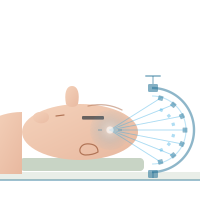
- MR-guided focused ultrasound (MRgFUS) — sound waves are focused through the skull to create a small lesion in a single session. No incision, no implant.
- For essential tremor: unilateral thalamotomy (FDA-approved 2016)
- For tremor-dominant Parkinson's: unilateral thalamotomy (2018), expanded in 2021 to also address mobility, rigidity, and dyskinesia
- For advanced Parkinson's: staged bilateral pallidothalamic tractotomy (FDA-approved 2025; the second side is treated at least six months after the first)
- Gamma Knife radiosurgery (stereotactic radiosurgery) — focused radiation through a fitted frame, no incision. Used as an alternative when DBS or MRgFUS aren't feasible (for example, patients on blood thinners, with bleeding risk, or who cannot tolerate surgery). The tremor benefit develops gradually over months.
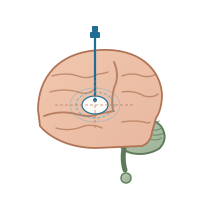
- Laser interstitial thermal therapy (LITT) — minimally invasive MRI-guided ablation through a small skull opening. Used in select cases where a focal lesion is preferred over a stimulator (for example, status dystonicus or when DBS hardware can't be tolerated). Less commonly used for movement disorders than for epilepsy.
Epilepsy & seizures.
If you have seizures that haven't fully responded to medications, you may be a candidate for a surgical evaluation. The first step is almost never surgery — it's a careful workup with the team at the Penn Comprehensive Epilepsy Center to find out where in the brain your seizures are starting and decide which option fits best. Some patients are best served by removing or ablating a small area; others are better served by a device that delivers stimulation. We offer all of these.
Conditions we treat
- Drug-resistant epilepsy — seizures that haven't fully responded to two or more medications.
- Focal seizures — seizures that start in a specific part of the brain.
- Mesial temporal lobe epilepsy with hippocampal sclerosis — the most common form of focal epilepsy in adults.
- Lesional epilepsy — seizures from a tumor, cortical dysplasia, or cavernoma.
- Hypothalamic hamartoma — a rare deep-brain lesion that causes seizures, treatable with LITT.
- Bilateral or eloquent-cortex seizure foci — when seizures come from both sides of the brain or from areas that can't safely be removed.
Procedures we offer
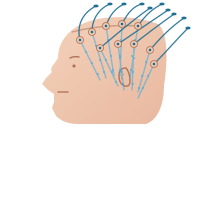
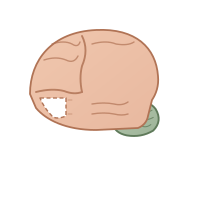
- Stereo-EEG (SEEG) monitoring — a short hospital stay where thin recording electrodes are placed in specific deep parts of the brain to track your seizures and pinpoint where they start. This is the diagnostic step that guides which treatment comes next.
- Anterior temporal lobectomy / selective amygdalohippocampectomy — open surgery to remove the small area where seizures start. The selective version preserves more surrounding brain tissue when only the deep mesial structures are involved. Long-term seizure-free rates of about 70–80% in well-selected patients.
- Lesionectomy — surgical removal of a tumor, cortical dysplasia, or cavernoma that's causing seizures.
- Laser interstitial thermal therapy (LITT) — a thin laser fiber is guided through a small skull opening to gently heat and stop the small area of brain tissue causing seizures. Used for mesial temporal lobe epilepsy (a procedure called SLAH) and for hypothalamic hamartomas. Usually a 1–2 day hospital stay; better cognitive recovery than open resection in many cases.
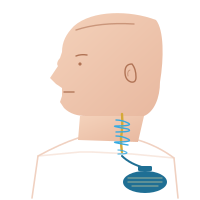
- Vagus nerve stimulation (VNS) — a small pacemaker-like device in the chest connected to a wire wrapped around a nerve in the neck. Adjunctive (added on top of medications); aim is reducing seizure frequency rather than seizure-freedom.
- Responsive neurostimulation (RNS, NeuroPace) — a small device implanted in the skull with one or two leads placed at the seizure focus. The device continually monitors your brain activity and delivers a brief, imperceptible stimulation when it detects abnormal patterns — often before a seizure becomes noticeable. Useful when seizures come from two foci, both sides of the brain, or from areas that can't safely be removed. Long-term studies show seizure reductions of 50–70% that grow over time.
- Deep brain stimulation of the anterior thalamus (DBS-ANT) — bilateral DBS in the anterior thalamic nucleus to reduce focal seizure frequency. FDA-approved 2018 based on the SANTE trial, which reported a median 75% seizure reduction at seven years post-implant.
Pain & nerve pain.
Most pain is best treated by a primary doctor or pain specialist. We treat specific kinds of nerve pain — usually after medications and other approaches haven't been enough — and we also evaluate spinal pain that might benefit from spine surgery or a stimulator. Most of what we offer is neuromodulation: small implanted devices that calm the nerves carrying the pain signal, without destroying any tissue. The right device depends on where your pain is and what kind of nerves are involved. Almost every device begins with a temporary trial so you can see whether it works for you before anything is permanently implanted.
Conditions we treat
- Trigeminal neuralgia — severe, sudden, electric-shock-like facial pain.
- Occipital neuralgia — sharp, shooting pain at the back of the head.
- Refractory chronic back and leg pain — including pain after spine surgery (sometimes called failed back surgery syndrome) and chronic radicular pain.
- Complex regional pain syndrome (CRPS) — burning, color-changing, hypersensitive pain in a hand, foot, or limb, often after an injury or surgery.
- Painful diabetic neuropathy — burning or shooting nerve pain in the feet from long-standing diabetes.
- Refractory chronic migraine and cluster headache — when the standard medications and CGRP-blockers haven't been enough.
- Persistent post-surgical neuropathic pain — including post-mastectomy, post-thoracotomy, post-amputation, and groin pain after hernia repair.
- Chiari malformation — when the lower brain extends into the spinal canal and causes symptoms.
Procedures we offer
- Microvascular decompression (MVD) — surgery to take pressure off the trigeminal nerve from a nearby blood vessel. Often the most durable option for classical trigeminal neuralgia.
- Percutaneous procedures for trigeminal neuralgia — short outpatient procedures done through a needle in the cheek under brief anesthesia (glycerol rhizotomy, balloon compression, radiofrequency rhizotomy). They interrupt the trigeminal nerve's pain fibers. Less invasive than MVD but typically shorter-lasting.
- Gamma Knife radiosurgery — focused radiation directed at the trigeminal nerve. No incision; pain relief usually develops over weeks to months.
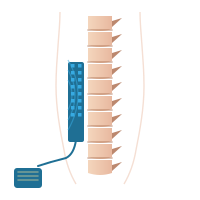
- Spinal cord stimulation (SCS) — a small implanted device with thin wires placed in the epidural space that delivers gentle electrical pulses to the spinal cord. Used most often for chronic back-and-leg pain after spine surgery, CRPS, and painful diabetic neuropathy. Modern devices offer multiple stimulation patterns (tonic, burst, and high-frequency 10-kHz) — the right one depends on what works best for you in trial.
- Dorsal root ganglion (DRG) stimulation — a more focal form of stimulation. Thin leads are placed near the small clusters of pain-sensing nerves just outside the spinal cord (the dorsal root ganglia). Particularly effective for CRPS and other focal neuropathic pain in the lower limbs or groin where standard SCS doesn't reach the right area.
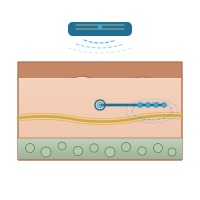
- Peripheral nerve stimulation (PNS) — a small device with leads placed near a specific nerve causing pain (for example, in the shoulder, knee, foot, or after amputation). Some PNS systems are designed as a temporary 60-day implant; others are permanent. Modern wireless systems (Nalu, StimRouter) have no internal battery — a small skin-worn transmitter delivers power transcutaneously to the implanted lead.
- Occipital nerve stimulation (ONS) — leads placed under the skin at the back of the head over the occipital nerves, connected to a small chest IPG. Used for refractory occipital neuralgia, chronic migraine, and cluster headache when other options haven't worked.
- Trigeminal nerve field stimulation — leads placed under the skin of the face along the painful trigeminal branches, for refractory trigeminal pain when surgery and medications haven't been enough. Reversible — no nerve tissue is destroyed.
- Intrathecal drug-delivery pump — a small pump implanted in the abdomen that delivers pain medication directly to the spinal fluid, achieving better pain control at much lower doses than oral or IV medication.
- Spine surgical evaluation — for back or leg pain that may need surgical treatment of the underlying problem (disc, stenosis, instability) before — or instead of — a stimulator.
The choice between SCS, DRG, and PNS comes down to where your pain is and what nerves carry it. SCS is best for broad areas like both legs or the lower back. DRG focuses on a smaller, anatomically specific area like one foot or the groin. PNS targets one peripheral nerve, like the suprascapular nerve in the shoulder. ONS and trigeminal field stimulation are versions of PNS for very specific head and face pain. We do a careful evaluation — including a temporary trial of the device — before any permanent implant.
Stroke — restoring arm and hand function.
If you had an ischemic stroke six or more months ago and your arm or hand still hasn't fully recovered, paired vagus nerve stimulation (paired VNS) may help. It combines a small implanted device with intensive rehabilitation to help your brain rebuild the connections that move your arm — even years after the stroke.
Who is a candidate
- Chronic ischemic stroke — the stroke happened at least 6 months ago. Many patients in the original trial were 1 to 3 years out.
- Moderate-to-severe arm weakness that hasn't fully recovered with standard rehabilitation alone.
- Some preserved arm and hand movement — you can move your wrist, your thumb, and at least two fingers a little.
- Motivation to commit to rehab — the device works with therapy, not instead of it. The protocol is intensive (multiple sessions per week for about six weeks, plus daily practice at home).
What we offer
- Paired vagus nerve stimulation (paired VNS) — a small pacemaker-like generator sits on the left chest, just under the collarbone, and a thin wire is tunneled under the skin to gently wrap around the left vagus nerve in the neck. The surgery is short (about an hour) and most patients go home the same day or the next morning.
- Paired rehabilitation — during therapy sessions, your therapist triggers a brief, painless stimulation each time you successfully attempt a movement. The stimulation pairs with the action and helps your brain reinforce the pathway. After the in-clinic block, you continue at home using a magnet you wave over the device while practicing daily activities.
- Standard stroke rehabilitation — physical therapy, occupational therapy, and the full multidisciplinary stroke team at the Penn Comprehensive Stroke Center.
Paired VNS was FDA-approved in 2021 based on the VNS-REHAB pivotal trial (Dawson et al., Lancet 2021): a randomized, triple-blind, sham-controlled trial of 108 patients with chronic ischemic stroke and moderate-to-severe arm impairment. Patients who received paired VNS plus rehabilitation showed roughly two to three times more improvement in arm function than patients who received the same intensive rehabilitation alone. Most participants were 1–3 years post-stroke at enrollment.
If you'd like to be evaluated for paired VNS therapy, ask your neurologist or rehab physician for a referral, or use the three contact options below to reach the clinic directly. The first visit is a multidisciplinary evaluation with neurosurgery, stroke neurology, and rehabilitation medicine to confirm that you're a good candidate.
Two clinic locations.
Most patients are first seen at Pennsylvania Hospital in Center City Philadelphia. A second clinic in Lancaster is available for patients in central Pennsylvania.
Penn Neurosurgery — Pennsylvania Hospital
801 Spruce Street
Philadelphia, PA 19107
Phone: 215-829-6700
Get directions on Google Maps →LG Health Physicians Neurology — Harrisburg Pike
2150 Harrisburg Pike
Lancaster, PA 17601
Phone: 717-396-9167
Get directions on Google Maps →Excerpts from patient reviews.
Selected from 400+ verified patient reviews on Penn Medicine. Quoted exactly as written; identities are not surfaced by Penn.
“Explained everything very well and gave me options.”
— Patient review · Penn Medicine
“They were very nice and didn't mind me asking questions.”
— Patient review · Penn Medicine
“Felt confident in his knowledge and expertise.”
— Patient review · Penn Medicine
Three ways to make an appointment.
- 1. Through your current doctor. Ask them to send a referral to Penn Neurosurgery — Functional & Stereotactic Service. This is the most common path and is helpful because your doctor can send your records ahead of the visit.
- 2. By phone. Call Penn Medicine's main appointment line at 800-789-7366, or call the Pennsylvania Hospital clinic directly at 215-829-6700. Tell them you'd like to schedule with Dr. Cajigas.
- 3. Through MyPennMedicine. If you are already a Penn patient, you can request the appointment yourself in the MyPennMedicine portal.
Most insurance plans are accepted, including Aetna, Cigna, Independence Blue Cross, UnitedHealthcare, Highmark, Medicare, and Medicaid (PA & NJ). Confirm coverage with your plan before the visit.
Many patients ask whether they can also help advance the research while being treated. The lab runs several IRB-approved studies that enroll patients already scheduled for surgery — your participation is voluntary and never affects your clinical care.
Frequently asked questions.
Do I need a referral to be seen?
A referral isn't strictly required, but most patients arrive with one — it lets your doctor send the relevant records (imaging, neurology notes, medication list) ahead of the visit, which makes the consultation more useful. If you'd like to come without one, call 800-789-7366 and ask.
How long is the first visit?
A new-patient consultation is typically 45–60 minutes. For movement disorders and epilepsy, you may also see a neurologist or epileptologist on the same visit — this is the team approach the Penn Comprehensive Epilepsy Center and Movement Disorders Center are built around.
What should I bring?
A list of all medications you take and the doses; a copy of your recent brain MRI on a CD or USB if you have one (the imaging center that did the scan can usually give you a copy); a list of questions; and ideally a family member or close friend — there's a lot to take in, and a second pair of ears is always helpful.
Will I be awake during deep brain stimulation surgery?
Sometimes, yes. For Parkinson's disease and essential tremor, the test portion of DBS is often done with you awake but very comfortable, because we ask you to do small tasks (tap your fingers, count) so we can confirm we have the lead in the right spot. You won't feel pain — only the brief setup is uncomfortable. The team will walk you through every step.
What's recovery like after laser ablation (LITT) for epilepsy?
Most people stay in the hospital for one or two nights after LITT, then go home. The incision is small (a few millimeters). Most patients return to light activities within a week or two. Seizure outcomes are followed for at least a year. Your epilepsy team will discuss what to expect for your specific situation.
Can my family come with me to appointments?
Yes — and we encourage it. For complex decisions about surgery, having a family member or trusted friend at the visit is genuinely helpful. They can ask questions you didn't think of and help you remember what was said.
Will I be invited to participate in research?
Possibly. Some patients are eligible to take part in research that can be done during a clinically planned procedure — for example, a few minutes of additional brain recording during DBS placement that doesn't change the surgery itself. Participation is always optional, separately consented, and reviewed by Penn's Institutional Review Board. It does not change your clinical care. See the Translation page for current research areas.
What if I'd like a second opinion?
Encouraged. Decisions about brain or nerve surgery are major. If you'd like a second opinion before deciding, we'll provide a written summary of our recommendations that you can share with another center.
How long after my stroke can I be considered for paired VNS?
The FDA-approved indication is for ischemic stroke at least six months in the past. In the pivotal trial, the average time since stroke was three years, and patients up to ten or more years out were enrolled — meaning recovery is still possible long after most rehabilitation programs end. The earliest you'd be eligible is around 6 months; there is no fixed upper limit, but we evaluate each patient individually.
How is paired VNS different from regular stroke rehab?
Standard rehabilitation works on its own, and many patients see meaningful improvement with it alone. Paired VNS is added on top of high-intensity rehabilitation for patients whose arm function has plateaued and is still moderate-to-severely impaired. The device delivers a brief stimulation paired with each movement attempt, which appears to enhance the brain's ability to relearn the motor task. In the pivotal trial, patients who got paired VNS plus rehab improved 2–3 times more than patients who got the same intensive rehab without the device.